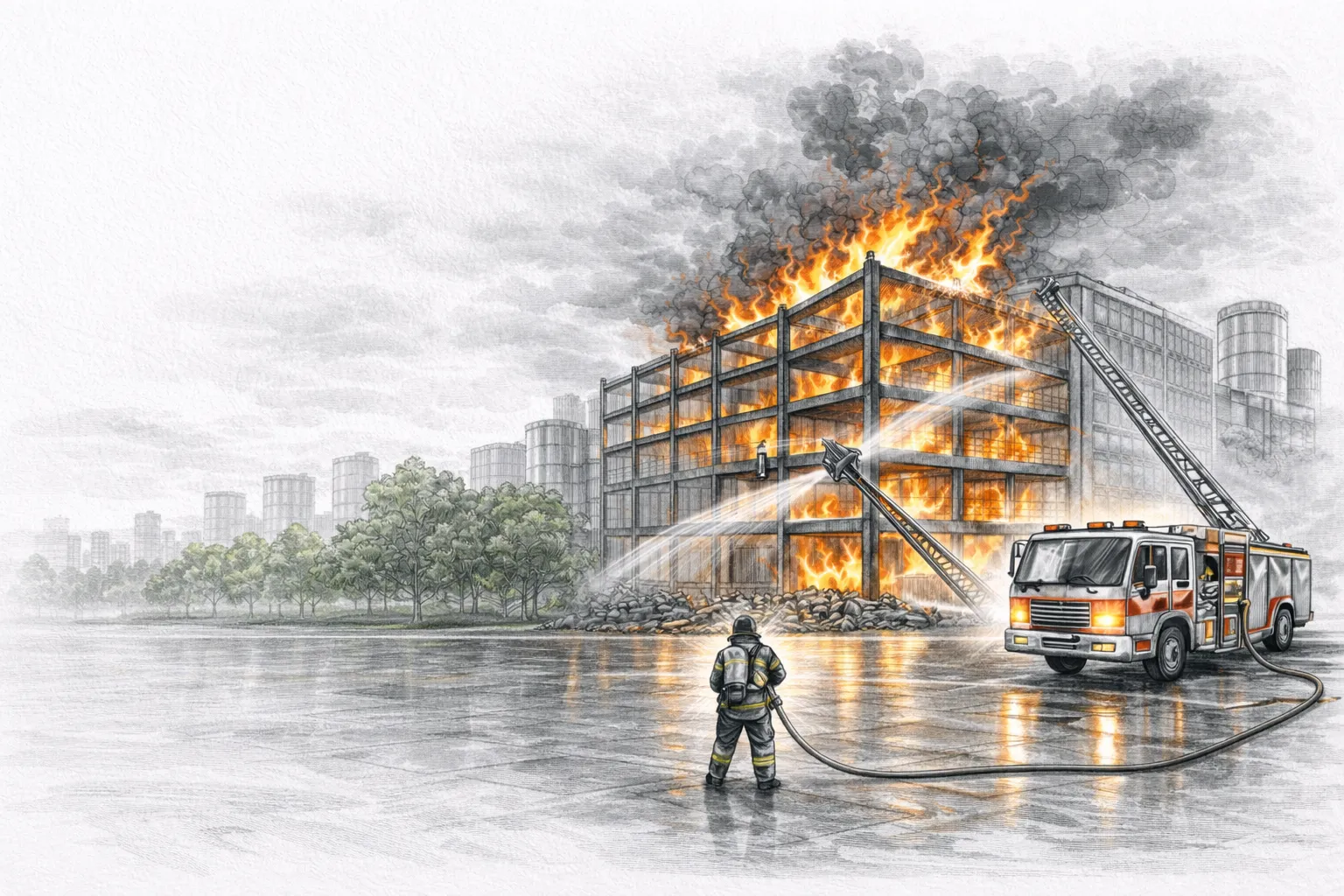
Critical Temperature and the Importance of Fire Insulation in Steel Structures
The durability of steel structures at high temperatures is well known and documented. At temperatures above 500°C, hot-rolled structural steel loses a significant portion of its load-bearing capacity at normal temperatures. Steel frame structures can be designed so that the maximum stresses in steel elements are limited to 60% of their maximum capacity at room temperature. This additional 40% reserve provides the structure with extra strength in abnormal situations such as fire. Depending on the size, shape and orientation of the element, this additional capacity can correspond to a collapse temperature of 550°C. At above 550°C, the structural steel element does not have sufficient strength to support the structure it carries. This is the limiting or critical temperature.
How Does Intumescent Fire-Resistant Coating React to Fire?
As noted above, if the limiting temperature is 550°C before the structural steel collapses, the intumescent fire-resistant coating begins to protect immediately after the fire starts. This is linked to the chemical reaction of the coating and represents its transformation from paint to an insulating barrier. When the char barrier forms, it begins to slow the accumulation of heat in the steel core at a slower rate. Depending on the thickness of the coating, the time required to reach the limiting temperature is extended.
Why Does Higher Temperature Require Less Coating Thickness?
Although this is not an absolute value, at a limiting temperature of 350°C compared with 750°C, approximately 6 times more intumescent coating may be required to protect the same piece of steel for 60 minutes. While the coating remains the same, the protection requirement varies.
Why Is Critical Temperature Important in Steel Protection?
To understand the importance of critical temperature, consider that when steel is used at a very high rate — i.e. stressed almost to the limit of its capacity — the failure temperature can be 350°C. There is almost no extra strength resistance against high temperatures. When designing a structure and applying the principles, the actual limiting or critical temperatures of steel structures are determined. If the steel utilisation is known, this can be calculated. If not, the default limiting temperature in the country's building code should be used.